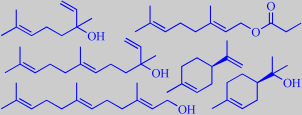
linalool, geranyl propionate, nerolidol, farnesol,
limonene and alpha-terpineol
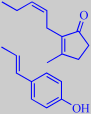
(Z)-jasmone,
anol
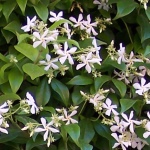
Star jasmine
Trachelospermum jasminoides (Apocynaceae)
From a distance this climbing plant resembles a jasmine, hence it's popular
name. However, it belongs to the Milkweed family, Apocynaceae, also including
frangipani
and yellow oleander,
for example.
Star jasmine is native to Southeastern Asia including Japan, Korea, southern
China and Vietnam and is now grown in many subtropics as a popular ornamental
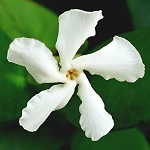
plant. The white flowers are about 2 cm in diameter with a tube-like corolla
opening up into five petal-like and slightly jagged lobes arranged like
propeller blades. The flowers are fragrant but do not match the character
and intensity of jasmine.
In China the plant, here called Luoshiteng, is used in folk medicine to
treat rheumatic arthralgia, aching of loins and knees, and traumatic injuries.
Napoli et al. investigated the essential oil from the flowers of star
jasmine by hydrodistillation followed by GC-MS. The flowers were collected
in a private garden located in the southern part of Italy (Catania, Eastern
Sicily). Main compounds were found to be linalool (26.2%), geranyl propionate
(8.7%), (Z)-jasmone (7.3%), farnesol (5.1%), nerolidol (3.3%), limonene
(3.0%) and alpha-terpineol (2.6%) [359].
An unusual floral volatile, anol or (E)-4-propenylphenol, was identified
as a minor constituent (about 4 %) in the headspace of star jasmine flowers
by Daniel Joulain (Research Laboratories, Robertet S.A.) [273].


DHF, furaneol
or strawberry furanone
-3-hexenal.gif)

3(Z)-hexenal
and diacetyl
strawberry esters
Strawberry
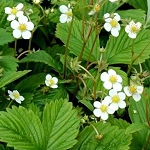
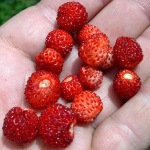
Fragaria vesca (Rosaceae) Woodland strawberry
Cultured sorts of strawberries are originating from hybrids between different
American species, especially Chile strawberry, F. chiloensis,
and Virginia strawberry, F. virginiana. There are numerous varieties.
However, the aroma of ripe woodland strawberries is second to none.
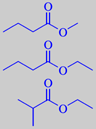
The joyful strawberry aroma is a charming accord of fruity elements: saturated
aliphatic esters, carboxylic acids, 2-ketones and lactones, 'green' elements:
2/3-(E)/(Z)-hexenol/hexenal, caramel elements: 2,5-dimethyl-4-methoxy-3(2H)-furanone
(DMF) and 2,5-dimethyl-4-hydroxy-3(2H)-furanone (DHF), floral elements:
linalool and nerolidol, and spicy-floral elements: methyl anthranilate
and eugenol - to name the most important constituents [29] [100] [101].
cinnamyl cinnamate and
hydrocinnamyl cinnamate
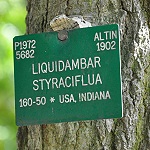
Liquidambar styraciflua (Altingiaceae) American sweetgum
Liquidambar orientalis (Altingiaceae) Oriental sweetgum
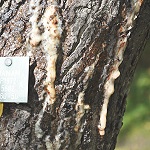
The American sweetgum tree is one of the larger trees of the Atlantic North America. In Florida it may reach a
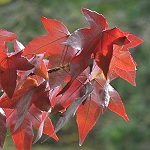
height of 50 m, whereas trees grown as ornamentals in European gardens and parks never become so large. The leaves are resembling those of Maple (Acer) and turn bright red in the autumn.
As the Latin name suggests, Liquidambar styraciflua exudes a balsam or fragrant resin (Lat. styrax) when injured. Styrax, especially that of L. orientalis, is still an item of commerce from which refined products are derived for perfumery purposes. The balsam is collected from the bark of artificially injured trees. The above photos are from the Botanical Garden in Copenhagen.
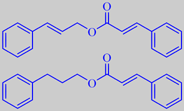
Styrax balsam has a "balsamic" smell characteristic of higher cinnamates. The main ingredients are cinnamyl cinnamate (styracine) and hydrocinnamyl cinnamate (3-phenylpropyl cinnamate). Several other constituents are present, among them traces of styrene [303].
Etymology: The generic Latin name, styrax, meaning balsam or fragrant resin, is also found as the genus name of the unrelated Benzoin trees, Styrax benzoin and Styrax tonkinensis (Styracaceae), from which the more valuable gum resin "benzoe" is obtained. Styrene (vinylbenzene or phenylethylene), now a major petrochemical item, owes its name to styrax since it was obtained by destructive distillation of this balsam (by decarboxylation of cinnamic acid) in the early years of organic chemistry.

styrene
-anethol.gif)
(E)-anethole
Myrrhis odorata (Umbelliferae)
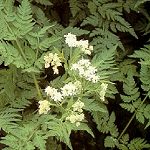
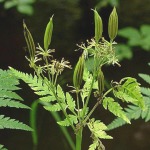
This beautiful umbellifer origins in the mountainous regions of Central Europe. It has been grown as a medicinal plant in the monasteries, and now it has spread to most of Europe. In Denmark, for example, it is found here and there along the roads in forests and in the countryside. You only have to rub the leaves to experience the magnificent anise flavour, due to the aromatic compound (E)-anethole (see also anise and star anise) [149].
Etymology: Gr. myrrhis, an erroneous reference to the fragrant Myrrh gum-resin.
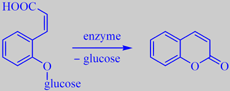
formation of coumarin from its glycoside
Sweetclover
Melilotus albus (Fabaceae) White sweetclover
Coumarin is found in many plants - sweetgrass, vernal grass, sweetclover,
woodruff, lavender,
tonka beans,
etc.
In the fresh, living plants coumarin is mostly present as a glycoside
(e.g. melilotoside in sweetclover), but when the plants are injured or
wither, the glycosides are split by enzymes [70] [102]. The sweet smell
of new-mown hay may be due to coumarin from the grasses mentioned above.
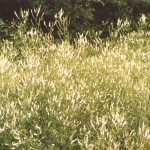
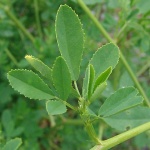
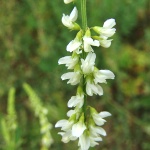
In Denmark, sweetclover is a common weed on fallow fields, along railway
lines, etc. Extracts from sweetclover, 'Melilotus absolute', has been
used in flavouring tobacco.
Etymology: Lat. melis, honey, sweet.
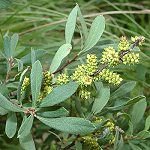
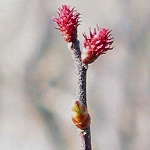
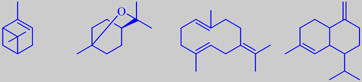
alpha-pinene, 1,8-cineole, germacrene B, and gamma-cadinene
Sweet Gale
Myrica gale (Myricaceae) Bog myrtle
Sweet gale is a little bush with fragrant leaves growing in heather moors,
where it may form dense stands along banks or where running water is frequent.
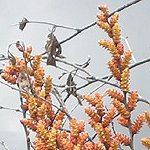
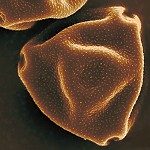
The photos show - from upper left to lower right - twigs with leaves and
unripe fruits, female flowers, male flowers, and pollen.
The gale family consists of about sixty species in one genus Myrica,
with sweet gale as the only species in Northern Europe. Probably the gale
family should be reckoned as a member of the walnut
order, Juglandales, with which it shares the build of the flowers, pollen,
seeds, and the number of chromosomes.
In old times, before hops became commonly grown, the leaves of sweet gale
were used for flavouring beer, and they are still used for making bitters
(In Denmark: Aalborg Porse Snaps,
Products > Aquavit > Aalborg Aquavit).
Leaves and fruits are covered with resinous glands containing an essential
oil, rich in mono- and sesquiterpenes. Alpha-pinene, 1,8-cineole, germacrene
B and gamma-cadinene are among the major components [7]. There is some
variation depending on location and genotype.
Recently there has been an increased interest in the volatile oil from
sweet gale as a repellent against the highland biting midge, Culicoides
impunctatus (Diptera: Ceratopogonidae).
Etymology: Gr. myron, perfume.